The short answer: test properly before you try to change anything. Yellow leaves have several causes, sulphur only works if there's no free lime in the soil, and the longest-lasting fix is changing what you put on top.
Every autumn I sow a winter green manure on my no-dig beds, and every year it quietly gets on with its job. This year it did something more useful. It told on the soil.
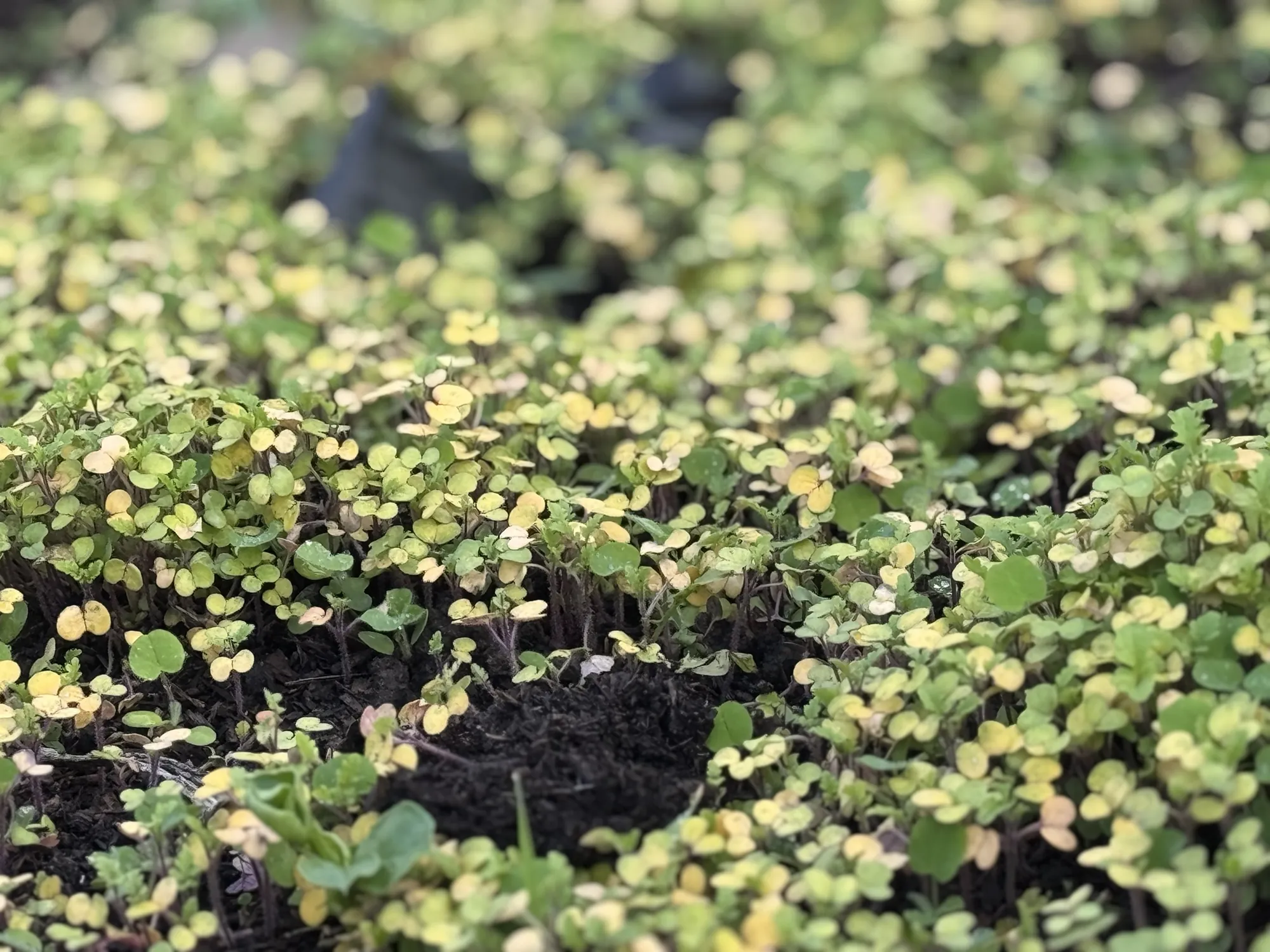
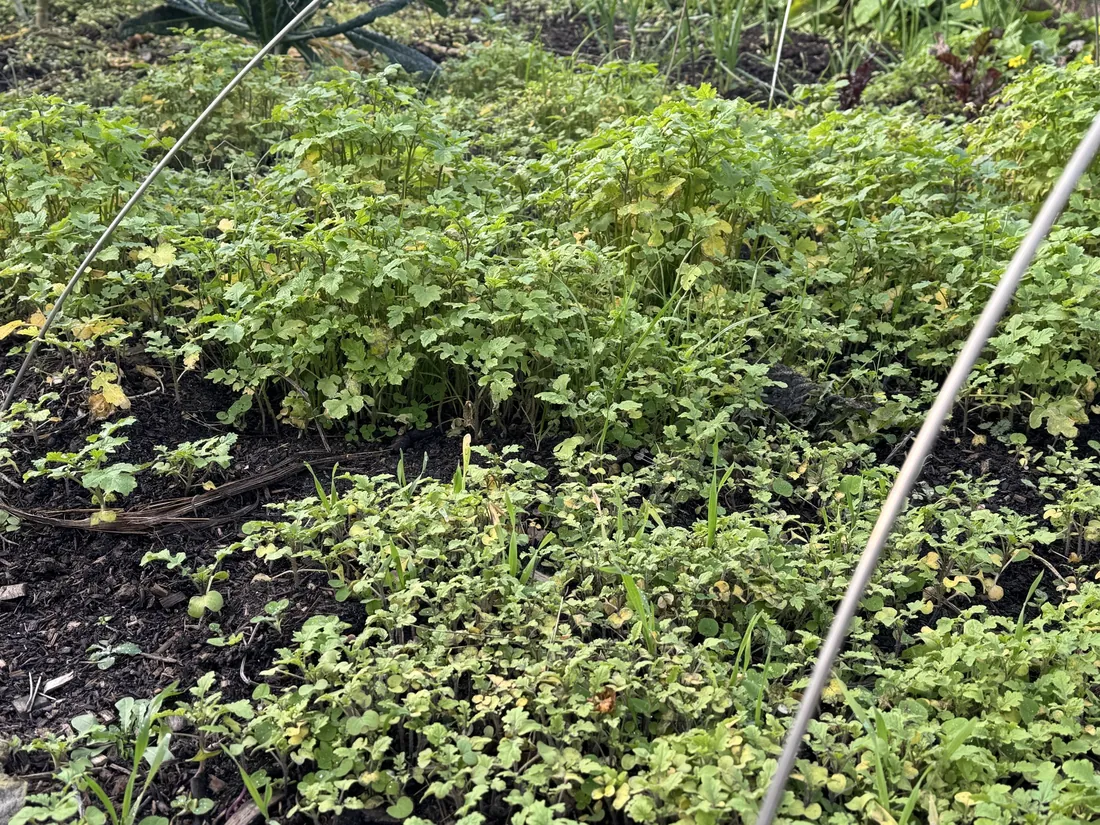
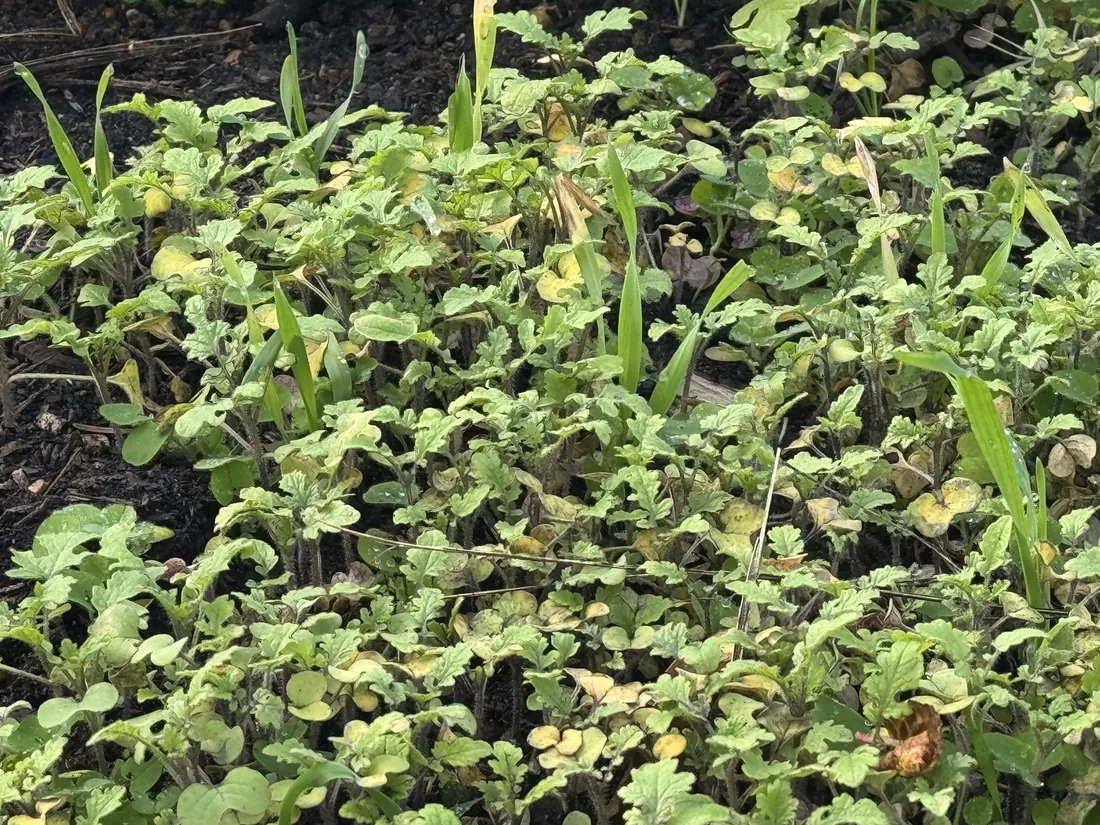
Within a few weeks of sowing, much of the bed had gone pale. The mustard seedlings have yellow, almost cream seed leaves, some stems have turned purple, and there are bare patches where little came up at all. Right next to them, one block of phacelia and mustard is lush and green. Seeing the two side by side made sense of something I'd been half-noticing all year: stunted growth, the odd good crop, and plants that never really got going.
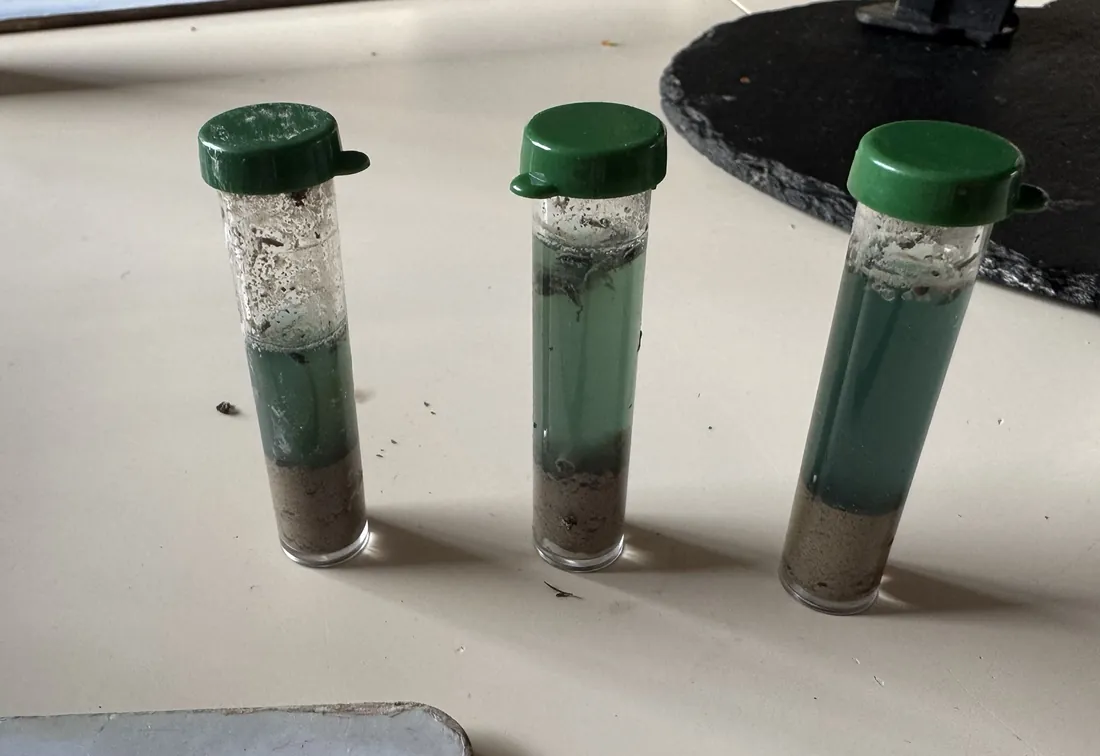
A home pH kit came back blue-green, which on the colour chart reads as mildly to moderately alkaline, around pH 7.5 or above. So is it alkaline soil? Possibly. But after twenty years of this I know better than to diagnose a bed from three test tubes.
Read the leaves before you blame the pH
Where the yellowing shows on the plant is your first clue. The RHS sets it out clearly:
- Iron deficiency, the classic lime-induced chlorosis of alkaline soils, shows on the youngest leaves first, with yellow between green veins.
- Manganese and magnesium deficiency usually start lower down, on older leaves. Sources disagree about manganese, so don't lean on this too hard.
- Nitrogen shortage gives a more general yellowing or reddening of the older leaves, and plants that simply lack vigour.
On my plants the yellowing is mostly on the seed leaves and lower leaves, with some bronzing and purple stems. That points to several things at once rather than one. The first is cold: these went in late, and November nights have been sharp. The second is a shortage of nitrogen right at the surface. This bed has a dark, woody top layer, and research by Linda Chalker-Scott at Washington State University shows that a band of low nitrogen forms where a woody mulch meets the soil. Established crops don't mind, but it's exactly where a sown seedling is trying to root. I wrote about this problem with mulch fines in my post on compost for no-dig beds.
High pH may well be part of it too, especially for manganese, which plants find harder to take up when soil is both alkaline and very rich in organic matter. That describes a heavily mulched no-dig bed rather well. But part of the problem isn't the whole problem, and the leaves alone can't tell me which part is which.
How to test properly
Colour-chart kits are fine for a first look, but a South Dakota State University trial found they generally land within a whole pH unit of a lab result. That's too wide a margin to spend money on. So I'm sending samples away.
The RHS Soil Analysis Service costs £36 per sample for members and £43 for non-members. It reports pH, texture, organic matter, phosphorus, potassium and magnesium. Commercial labs such as NRM offer suites that also measure carbonate content, and that's the figure I most want.
Free lime, meaning fragments of chalk or limestone in the soil, changes everything. Sulphur just gets used up neutralising it, and the pH barely moves. There's a rough check you can do at home first.
- The vinegar fizz test.Put a spoonful of soil on a saucer and add a little vinegar. If it fizzes, there's free carbonate. This is a test only: pouring vinegar on the bed won't change your pH in any lasting way.
- Sample in two layers.In a no-dig bed, take one sample from the top few centimetres of compost and another from the soil beneath, about 5 to 15cm down. They can tell very different stories.
- Mind the timing.The RHS warns that a test within three months of adding compost, lime or fertiliser can mislead.
Why no-dig beds can drift alkaline
No-dig means adding compost to the surface every year, and whatever is in that compost builds up right where your seeds and roots live.
Mushroom compost is the usual suspect. The RHS says spent mushroom compost can contain up to 30% chalk, that regular use builds chalk up in the soil, and that it isn't recommended for neutral or alkaline ground. Suppliers quote anything from about pH 6.3 to 8, so one load can be quite different from the next.
Peat-free green-waste compost often runs alkaline too. Government test data for PAS100 compost includes samples around pH 8, and some products are sold at pH 8 to 8.5.
Add garden lime, wood ash, or soil over limestone, and Halkyn Mountain is just up the road, and you can see how a bed creeps upwards over the years.
To be fair to the other side, Charles Dowding, whose no-dig methods I follow, thinks pH gets far more worry than it deserves. He has grown well on soil of pH 7.8 using very alkaline mushroom compost, and reckons anything from 6 to 8 is fine for vegetables. He has a point, and it's one more reason I'm testing before I treat.
The fixes, short term and long term
If there's free lime, don't fight it. The RHS is blunt that soil like this can't realistically be made acid. Change your compost, grow crops that like it, and use foliar feeds where plants need a hand.
If there's no free lime and the lab confirms a high pH, elemental sulphur is the standard fix. Soil bacteria turn it into acid, so it needs warmth. The RHS says it can take months in cold soil, so it goes on in spring, not November. Its guide is 135 to 270g per square metre to bring the top 15cm from about pH 7.5 down to 6 to 6.5, with the higher figure for clay and more again for soils rich in organic matter. It also advises several small doses rather than one big one. I'll start well below that, rake it lightly into the surface, and retest after six months. Overdo sulphur and you can make the soil too acid, which is far harder to live with.
Organic growers: the Soil Association permits elemental sulphur, but certified growers need records, such as a soil test, showing why it's needed.
Things that don't do much. Used coffee grounds are close to neutral and won't shift your soil. Ericaceous compost is for pots, not whole beds. Sulphate of ammonia acidifies only slightly, and it isn't organic.
For quick relief, a liquid sequestered (chelated) iron feed that also contains manganese and magnesium, or a seaweed foliar feed, can green plants up while you sort out the cause.
My winter trial
Before any of that, I'm running a simple trial on the green manure to narrow down the cause. I've marked out three patches of similar plants.
- Patch one: Epsom salts.20g per litre of water, roughly a level tablespoon, with two drops of washing-up liquid so it sticks. Sprayed until the leaves are just wet, and repeated after two weeks.
- Patch two: a liquid feed.A general liquid or seaweed feed at the label rate, to test for nitrogen.
- Patch three: left alone.The comparison.
If the Epsom salts patch greens up, it was magnesium. If the feed patch does, it was nitrogen. If nothing changes, cold or locked-up iron and manganese are more likely. I'm judging by the new true leaves, not the seed leaves, which won't recover. I'm spraying on a mild, dry morning, and allowing two to three weeks, because nothing happens quickly in November. Epsom salts won't change the pH, by the way. They only answer the magnesium question.
Long term, the real fix is what goes on top. I'm switching to my own compost, leaf mould and well-rotted manure, using mushroom compost sparingly if at all, and asking suppliers for their pH figures before I buy.
Crops that cope
Alkaline soil isn't all bad news. Brassicas are happy in it, and club root, the disease that wrecks them on acid ground, is much less of a problem. Kale, cabbages, beetroot and chard will all do well in this bed. Potatoes are the exception: common scab is more likely at higher pH, so they'll go in a different bed. Blueberries belong in pots of ericaceous compost wherever you garden.
My plan for this bed
| When | What to do |
|---|---|
| November | Leave the green manure in. Yellow or not, it's still protecting the soil. Start the three-patch trial and do the vinegar test. |
| November | Send two-layer samples to a lab, with carbonate included. Ask the compost supplier for its pH figure. |
| Winter | Read the results. Free lime: work with it. No free lime and a high pH: plan sulphur for spring. |
| March to April | Cut the mustard before it flowers and the rye when you can feel the flower bud in the stem. Leave the cuttings on the surface under a little compost, and wait about a month before sowing. If needed, apply sulphur in small, split doses once the soil warms. |
| Autumn 2027 | Retest, in the same two layers, to see what's actually changed. |
More on choosing and managing winter cover is in my guide to green manures.
Test before you treat, and change what goes on top.
Questions people ask
Can I fix alkaline soil quickly? No. Sulphur takes weeks in warm soil and months in cold. Foliar feeds give short-term relief while you deal with the cause.
Should I stop using mushroom compost? If your soil is already neutral or alkaline, use it sparingly, or not at all.
Is a home kit good enough? It's fine for spotting a trend. Get a lab test before you spend money correcting anything.
Should I dig the green manure in? Not in a no-dig bed. Cut it, leave it on the surface under a light layer of compost, and wait a few weeks before sowing.
If your own beds are sulking and you're near Mold, Holywell or the villages around, I'm happy to come and take a look, whether that's soil testing, setting up no-dig beds or a planting plan. Get in touch.
Further reading
- RHS: chlorosis and yellow leaves
- RHS: soil pH and testing
- RHS: acidifying soil
- RHS: Soil Analysis Service
- NRM: soil analysis
- Linda Chalker-Scott: the myth of nitrogen lock-up under wood chips
- Charles Dowding forum: soil pH
Written by Mark, The Garden Curator. RHS Level 3 qualified gardener working in Mold and the villages around it.