The previous post covered growing a green manure over winter and finishing it in spring without digging. If you keep hens, there's another way to finish it: turn them out onto it.
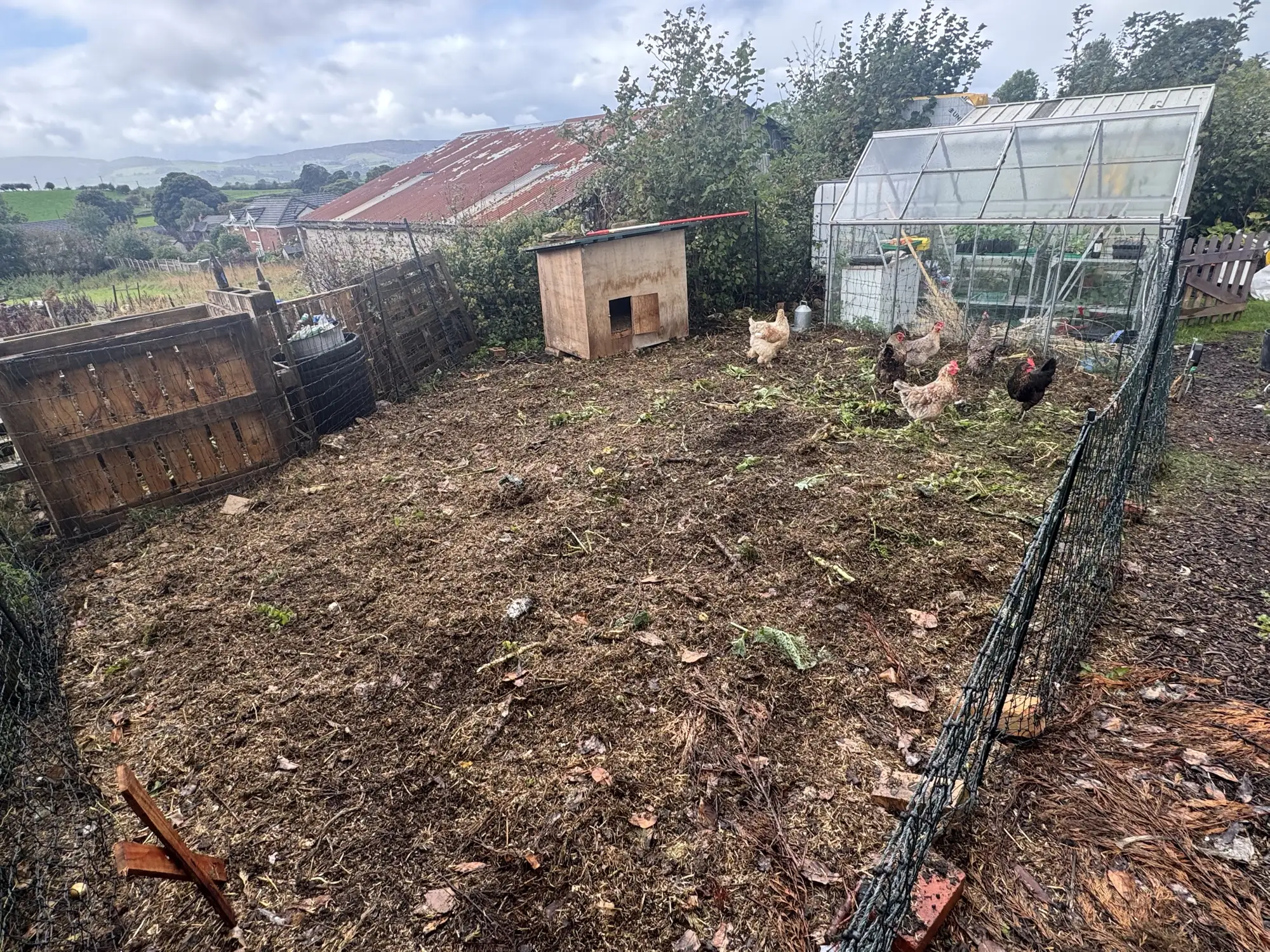
That's my own small flock in the photo above, on a bed in my veg garden. Hens and vegetables go together well, as long as you're in charge of when and where.
Why it works so well
Cut a green manure and leave it, and it rots down at whatever pace a cold, wet British spring allows, which can be very slow. Put hens on it and they eat the leaves, grind them up, and drop them back on the bed as concentrated manure, then scratch it into the surface for you.
The clever part is what happens to the carbon. A mature green manure is woody, and buried woody material makes soil bacteria lock up nitrogen while they break it down. Hens burn that carbon off as energy and hand back the nitrogen in a quick-release form. Trials of vegetable rotations with poultry have found no nitrogen lock-up at all, more nitrogen available to plants in spring, more earthworms and better drainage than with green manure alone. And because hens are light, the studies found no measurable compaction.
Those trials were on farms, with proper flocks, so don't expect the same numbers from four hens in a back garden. Expect the same direction.
Short grass for the hens, tall growth for the soil
There's a catch, and it's worth understanding. Hens get the most nourishment from a green manure when it's young and short, about 7.5 to 13cm (3 to 5 inches). Above that it gets stemmy and fibrous, and they get little from it. But the soil gets the most from a green manure when it's tall and just starting to flower. You can't have both from one grazing, so do it in two passes:
- An autumn pass.Late October to mid-November, when the crop is 10 to 15cm. Put the birds on for a day or three, and take them off when it's down to 5 to 8cm, so there's still enough leaf to regrow before winter.
- A finishing pass.In February. This time let them take it right down, and take them off the moment it's 2 to 5cm high.
That last instruction matters more than any other here. Move the hens on as soon as the crop is 2 to 5cm tall. Left any longer, they stop building soil and start wrecking it: they scratch it bare, break up its structure, and start eating the earthworms their own manure was bringing in. Lots of birds for a short time beats a few birds for a long time.
Keeping the hens safe
Some of the best green manures are harmful to poultry at the wrong stage, or at any stage. Hens don't have a cow's stomach to deal with plant toxins, so check the mix before you buy.
| Plant | The risk | The rule |
|---|---|---|
| Winter tares (vetch) and field beans | The leaves are excellent feed. The ripe seed is toxic to poultry and has killed birds. | Hens on before flowering. Crop finished, or hens off, before pods form. No exceptions. |
| Buckwheat | Makes birds badly sensitive to sunlight: sunburn and blistering. | Never in a mix hens can reach. |
| Flax or linseed | Too much can harm layers and taints the eggs. | Leave it out of grazed mixes. |
| Tall fescue | Can carry a fungus that causes shell-less eggs. | Check grass seed mixes before buying. |
| Grazing rye | If it's allowed to run to seed it can pick up ergot, a toxic fungus. | Finish it before it heads up. |
| Mustard | Bitter and irritating; hens mostly leave it, and it's dead by winter anyway. | Keep it for beds the hens don't use. |
| Black nightshade | Toxic berries, eaten when food runs short. | Walk the bed and pull it before the hens go on. |
Keep newly sown beds netted, too. Hens will happily eat your sown beans and rye before they've had a chance to come up.
Keeping yourself safe
Fresh chicken manure can carry Salmonella and E. coli, and they live in soil for a long time. This is the part people get wrong most often, so here's what the official UK guidance says.
The Food Standards Agency's guidance for growers of crops that are eaten raw asks for 12 months between livestock last grazing a field and the harvest, and at least 6 months between the last grazing and planting. Where grazing is essential, as on some organic farms, it allows a minimum of 6 months between grazing and harvest. It's written for commercial growers and it's voluntary, but it's the best UK benchmark there is. It's also much stricter than the 120-day rule you'll see quoted online, which comes from the United States.
Fresh manure is also strong enough to scorch young plants, so don't plant into a bed straight after the hens come off. Leave it to rest through March at least, while the soil life gets to work.
Three more things worth knowing
- Weeds can get worse, not better. It sounds wrong, but all that fresh manure feeds weeds as well as crops, and studies have found more winter weeds after grazing, not fewer. Follow the finishing pass with a mulch of cardboard and compost or woodchip, especially where grazing rye is trying to regrow.
- Mind the water. Farmers in Wales keep livestock and manure at least 10 metres from ponds and streams and 50 metres from a spring, well or borehole. It's a sensible line for a garden too. Keep hens off waterlogged or frozen ground, where manure just washes off the surface.
- Your own manure is cleaner than bought-in manure. Manure and straw from farms can carry weedkillers such as aminopyralid that survive composting and can twist and stunt beans, tomatoes and potatoes for years. Fertility your own hens make from green manure you grew yourself doesn't carry that risk.
If your hens are housed
If your birds don't free-range on the beds, compost their bedding and manure before it goes anywhere near your vegetables. Mix it well with plenty of straw, dry leaves or shredded cardboard so the heap heats up properly. The FSA guidance looks for a heap that stays above 55°C for at least three days, is turned regularly, and composts for at least three months in total. Leave it to mature after that and it's safe to use on anything.
The year at a glance
| When | What to do | Hens |
|---|---|---|
| Mid-Aug to mid-Sept | Sow the green manure. Net it. | Off |
| Late Sept to Oct | Let it establish. Re-sow gaps with rye or oats. | Off |
| Late Oct to mid-Nov | Autumn pass: on at 10 to 15cm, off at 5 to 8cm. | On, 1 to 3 days per bed |
| Mid-Nov to Jan | Leave it alone. Check there's no flowering in the tares or beans. | Off |
| February | Finishing pass: down to 2 to 5cm, then off. | On, then off for the season |
| Late Feb to March | Mulch any regrowth. Rest the bed. No digging. | Off |
| April onwards | Plant crops for cooking. Salads go in beds that weren't grazed. | Off |
Done this way, hens and green manures together are about the best way I know to bring a tired veg bed back to life without buying anything in.
Written by Mark, The Garden Curator. RHS Level 3 qualified gardener working in Mold and the villages around it.